
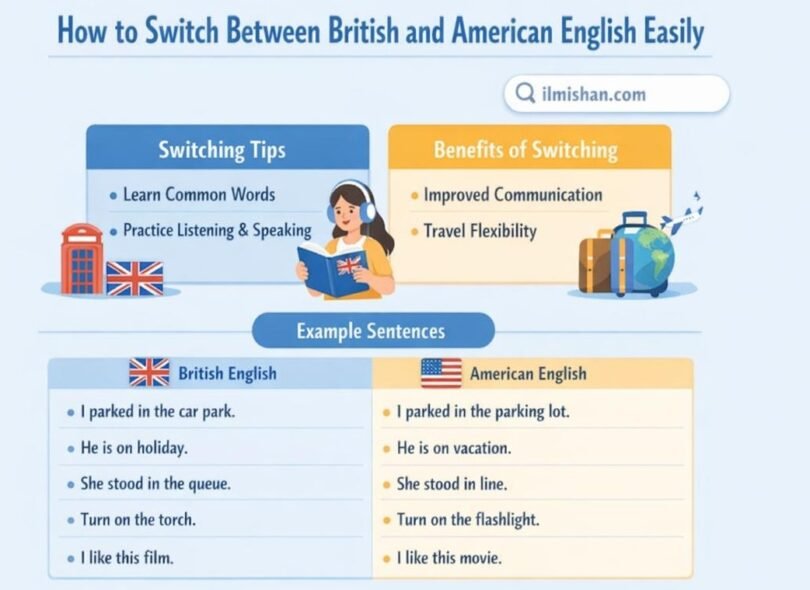

What Does Switching Between British and American English Mean?
Switching means changing your language style depending on the situation. You adjust your:
- Spelling
- Vocabulary
- Grammar
- Pronunciation
👉 For example:
- British: colour → American: color
- British: lift → American: elevator
The meaning stays the same, but the form changes.
Why Is It Important to Switch Correctly?
Understanding both styles helps you:
- ✔ Write correctly in exams and assignments
- ✔ Communicate with international audiences
- ✔ Avoid confusion in speaking and writing
- ✔ Improve your professional English skills
👉 Important Tip: In formal writing, always follow one style consistently.
Key Areas Where You Need to Switch
1. Spelling Changes
Spelling is the easiest and most common change.
| British English | American English |
|---|---|
| Colour | Color |
| Favourite | Favorite |
| Centre | Center |
| Theatre | Theater |
| Travelling | Traveling |
👉 Easy Rule:
British uses -our, -re → American uses -or, -er
2. Vocabulary Changes
Some everyday words are completely different.
| British English | American English |
|---|---|
| Flat | Apartment |
| Lift | Elevator |
| Holiday | Vacation |
| Petrol | Gas |
| Biscuit | Cookie |
👉 Example:
- British: I booked a holiday.
- American: I booked a vacation.
3. Grammar Adjustments
Grammar differences are small but important.
a) Present Perfect vs Past Simple
- British: I have just finished my work.
- American: I just finished my work.
👉 American English often prefers simpler past tense.
b) Prepositions
| British English | American English |
|---|---|
| At the weekend | On the weekend |
| In a team | On a team |
| Different to | Different from |
c) Collective Nouns
- British: The team are winning.
- American: The team is winning.
4. Pronunciation Switching
Pronunciation mainly changes in accent and sound.
- British English often drops the “r” sound
- American English pronounces the “r” clearly
👉 Example:
- Better → British: beh-tuh | American: bed-er
👉 Tip: You do not need to change your accent fully. Focus on clarity and understanding.
Easy Steps to Switch Between British and American English
✔ Step 1: Choose Your Base Style
Start with one form (British or American). Learn it well first.
👉 This builds a strong foundation.
✔ Step 2: Learn Common Word Pairs
Memorize frequently used pairs.
| British | American |
|---|---|
| Car park | Parking lot |
| Torch | Flashlight |
| Film | Movie |
| Queue | Line |
Easy Steps to Switch Between British and American English
✔ Step 3: Practice Sentence Conversion
Practice changing sentences from one form to another.
👉 Example:
- British: She is in the queue.
- American: She is in the line.
✔ Step 4: Use Tools and Settings
Set your devices to one language:
- Keyboard language (UK or US)
- Spell check tools
- Writing apps
👉 This helps you stay consistent.
✔ Step 5: Watch and Listen Actively
- Watch British shows for UK English
- Watch American movies for US English
👉 Listening improves natural switching ability.
✔ Step 6: Write Daily in Both Styles
Practice writing short sentences:
- British: My favourite colour is blue.
- American: My favorite color is blue.
Advanced Tips for Smooth Switching
✔ Understand Context
Use:
- British English → UK exams, IELTS, formal UK writing
- American English → Business, international communication, media
✔ Avoid Mixing Styles
❌ Incorrect: My favourite color is blue.
✔ Correct:
- British: My favourite colour is blue.
- American: My favorite color is blue.
✔ Focus on Meaning First
Do not panic about small differences. Clear meaning is more important.
Common Mistakes Students Make
- ❌ Mixing spelling styles in one sentence
- ❌ Using wrong vocabulary (like pants)
- ❌ Ignoring grammar differences
- ❌ Copying without understanding
Quick Practice Table
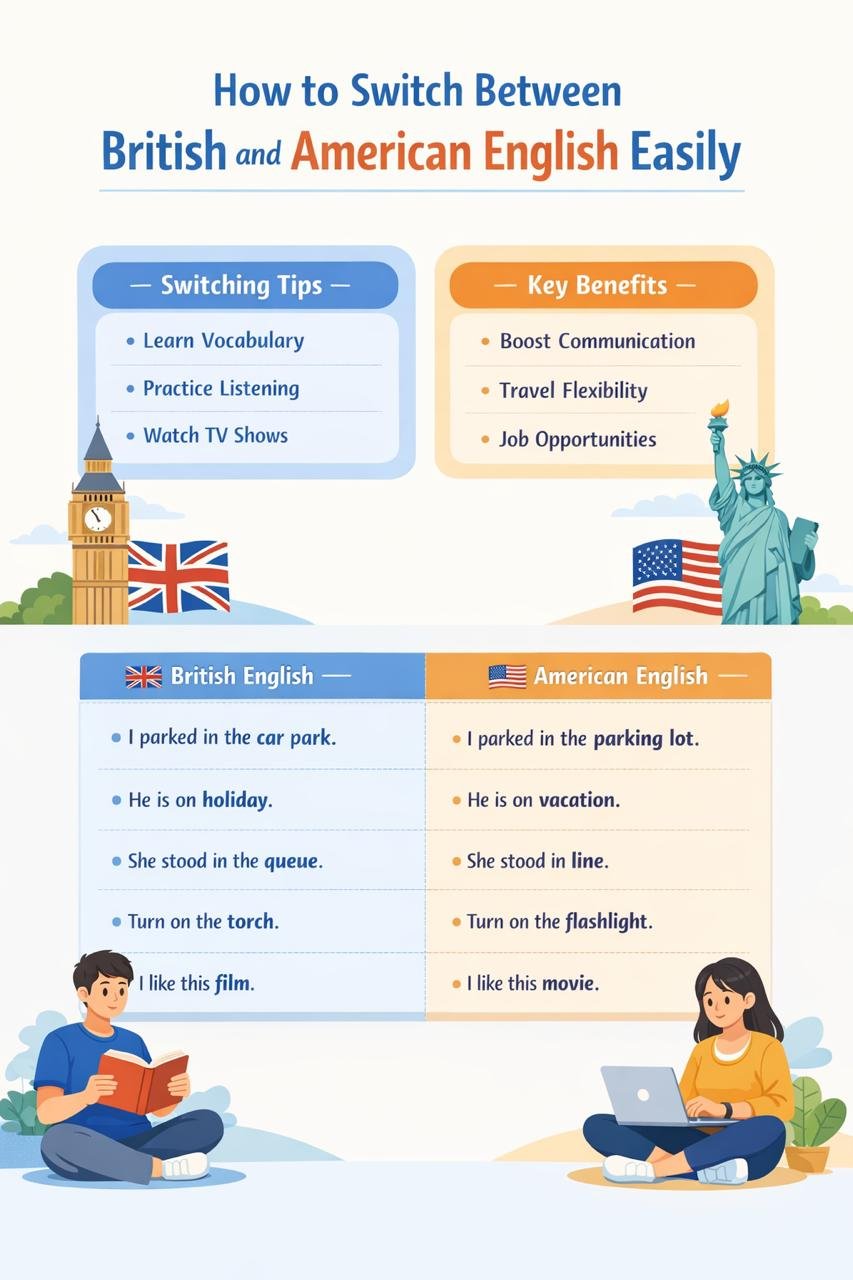
| British Sentence | American Sentence |
|---|---|
| I parked in the car park. | I parked in the parking lot. |
| He is on holiday. | He is on vacation. |
| She stood in the queue. | She stood in line. |
| Turn on the torch. | Turn on the flashlight. |
| I like this film. | I like this movie. |
Learn more helpful articles