
What Is a Verb?
A verb is the word in a sentence that shows an action, a state, or an event.
It tells what the subject does, is, or has.
A verb can show:
- Physical action — run, eat, write
- Mental action — think, remember, decide
- State of being — is, am, are, was, were
- Possession — have, has
Examples of Verbs
- She runs fast.
- They are happy.
- I think about my goals.
- He has a new phone.
In every sentence above, the verb tells what is happening.
What Is a Predicate?
A predicate is the complete part of a sentence that tells what the subject does or what happens to the subject.
It always starts with a verb but includes more words such as objects, complements, and phrases.
A predicate can include:
- The verb
- The object
- The complement
- The adverbs
- Any extra information about the action
Examples of Predicates
- She runs every morning.
- The children are playing in the garden.
- My brother has finished his homework.
- The shop opens at 9 AM.
The bold part in each sentence is the predicate, because it tells the whole information about the subject.
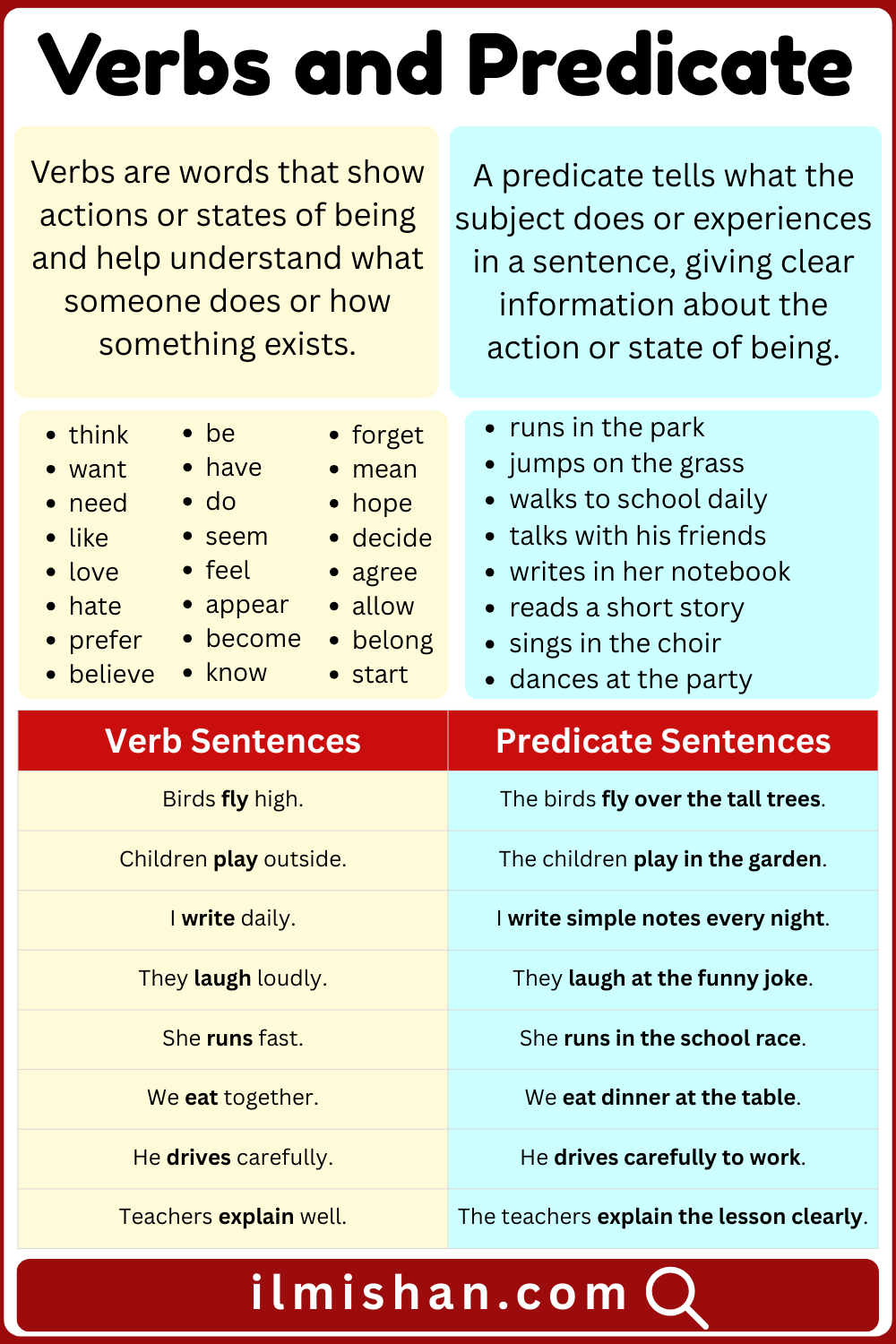
Verbs and Predicates with Examples in English
Key Difference Between Verb and Predicate
Below is a clear and simple table to understand the difference:
Verb vs. Predicate
| Point | Verb | Predicate |
|---|---|---|
| Meaning | Shows action or state. | Tells what the subject does or what happens. |
| Length | Usually one word (sometimes two or more in verb phrases). | A whole part of the sentence starting from the verb till the end. |
| Role | Only expresses action or state. | Gives complete information about the subject. |
| Includes | Only the verb (or verb phrase). | Verb + object + complement + modifiers. |
| Example | “eats” | “eats an apple every morning” |
How to Identify Verb and Predicate
How to Find the Verb
Ask the question:
“What is happening?” or “What is the action?”
Examples:
- They play football. → play is the verb
- She is reading a book. → is reading is the verb phrase
How to Find the Predicate
Ask the question:
“What is being said about the subject?”
Examples:
- The teacher explained the lesson clearly.
- My friends are going to the park.
Everything that starts from the verb and continues to the end of the sentence is the predicate.
Types of Verbs Relevant to Predicates
1. Action Verbs
These verbs show an action.
Example:
-
He writes neatly.
2. Linking Verbs
These verbs connect the subject to extra information.
Example:
-
She is smart.
3. Helping Verbs
These verbs support the main verb.
Examples:
- They are playing.
- She has finished.
All of these verbs can appear inside a predicate.
Types of Predicates
1. Simple Predicate
Only the verb or verb phrase.
Example:
- The baby cried.
- They are running.
2. Complete Predicate
The verb + all words related to the action.
Example:
- The baby cried loudly near the door.
- They are running in the field.
3. Compound Predicate
Two or more actions of the same subject.
Example:
- She washed the dishes and cleaned the floor.
- He opened the window and turned on the fan.
Examples to Show the Difference Clearly
Example 1
Sentence: The dog barked loudly.
- Verb: barked
- Predicate: barked loudly
Example 2
Sentence: The students are studying for the test.
- Verb: are studying
- Predicate: are studying for the test
Example 3
Sentence: My mother cooked dinner and cleaned the kitchen.
- Verbs: cooked, cleaned
- Predicate: cooked dinner and cleaned the kitchen
Example 4
Sentence: The sky looks beautiful this evening.
- Verb: looks
- Predicate: looks beautiful this evening
Common Mistakes Students Make in Verb and Predicate
Mistake 1: Thinking the Verb and Predicate Are the Same
A verb is only part of the predicate, not the whole predicate.
Mistake 2: Confusing Verb Phrases
Students sometimes pick only one word, but many verbs come in phrases.
Example:
-
She has been working → this is the full verb phrase.
Mistake 3: Forgetting Additional Details in the Predicate
Everything after the verb is part of the predicate.
Quick Practice for Students
Identify the verb and predicate in each sentence:
- The boy is running fast.
- My parents visited the museum yesterday.
- The cat is sleeping on the sofa.
- We will travel to Karachi tomorrow.
You can use these for class tests or homework practice.
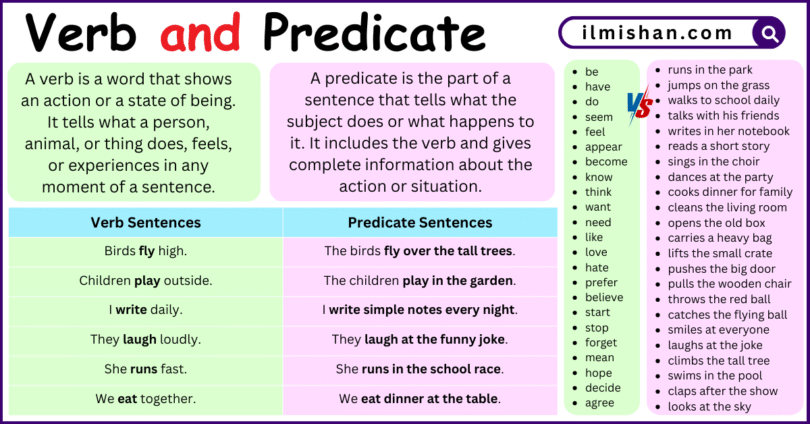
Examples of Verb and Predicate in English
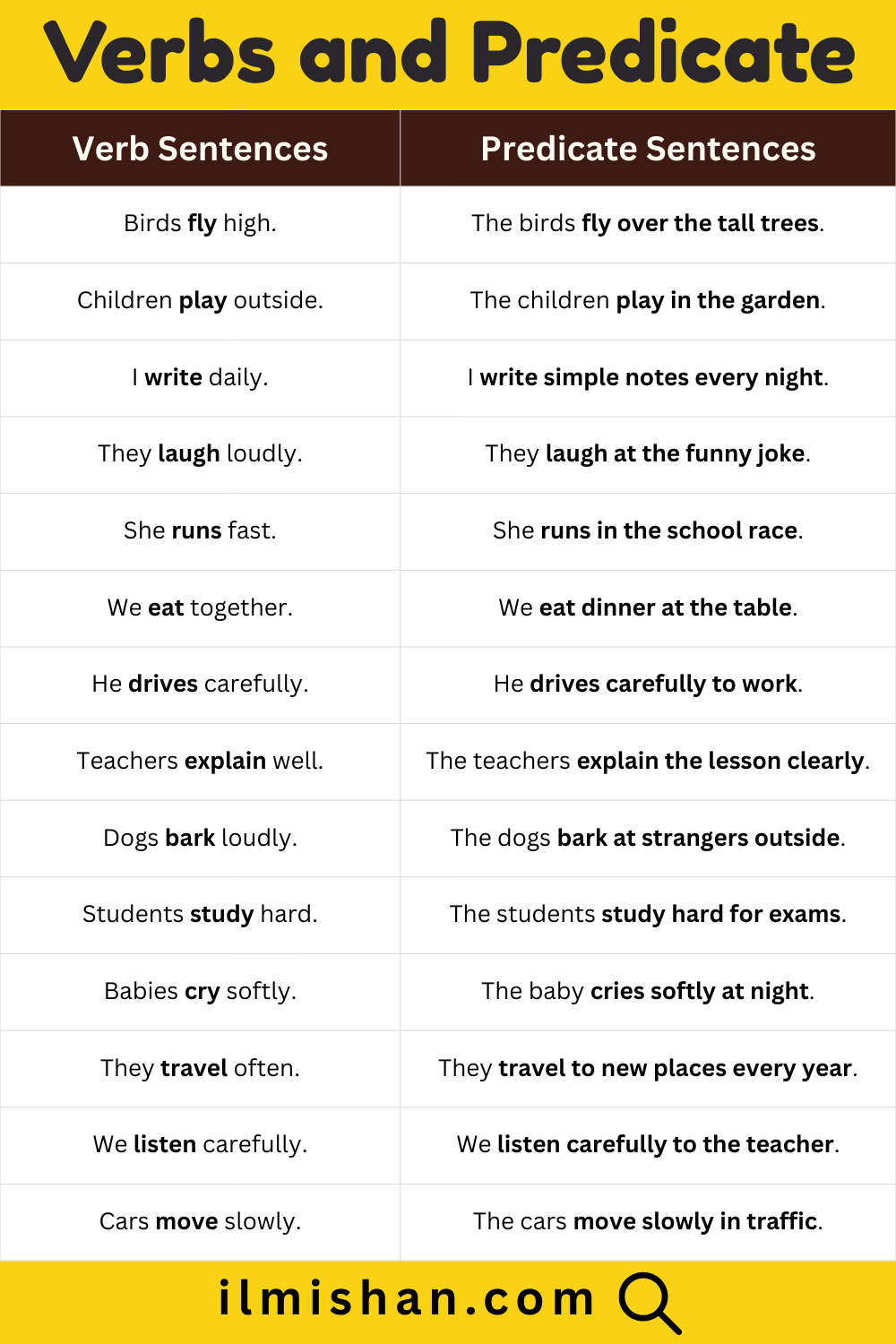
| Verb Sentences | Predicate Sentences |
|---|---|
| Birds fly high. | The birds fly over the tall trees. |
| Children play outside. | The children play in the garden. |
| I write daily. | I write simple notes every night. |
| They laugh loudly. | They laugh at the funny joke. |
| She runs fast. | She runs in the school race. |
| We eat together. | We eat dinner at the table. |
| He drives carefully. | He drives carefully to work. |
| Teachers explain well. | The teachers explain the lesson clearly. |
| Dogs bark loudly. | The dogs bark at strangers outside. |
| Students study hard. | The students study hard for exams. |
| Babies cry softly. | The baby cries softly at night. |
| They travel often. | They travel to new places every year. |
| We listen carefully. | We listen carefully to the teacher. |
| She draws beautifully. | She draws beautiful pictures daily. |
| Birds sing sweetly. | The birds sing sweet songs every morning. |
| Players practice daily. | The players practice daily after school. |
| Friends meet often. | My friends meet often at the park. |
| Cars move slowly. | The cars move slowly in traffic. |
| Leaves fall gently. | The leaves fall gently from the trees. |
| Kids jump happily. | The kids jump happily on the trampoline. |
Examples of Verbs and Predicates in English
Verbs List in English
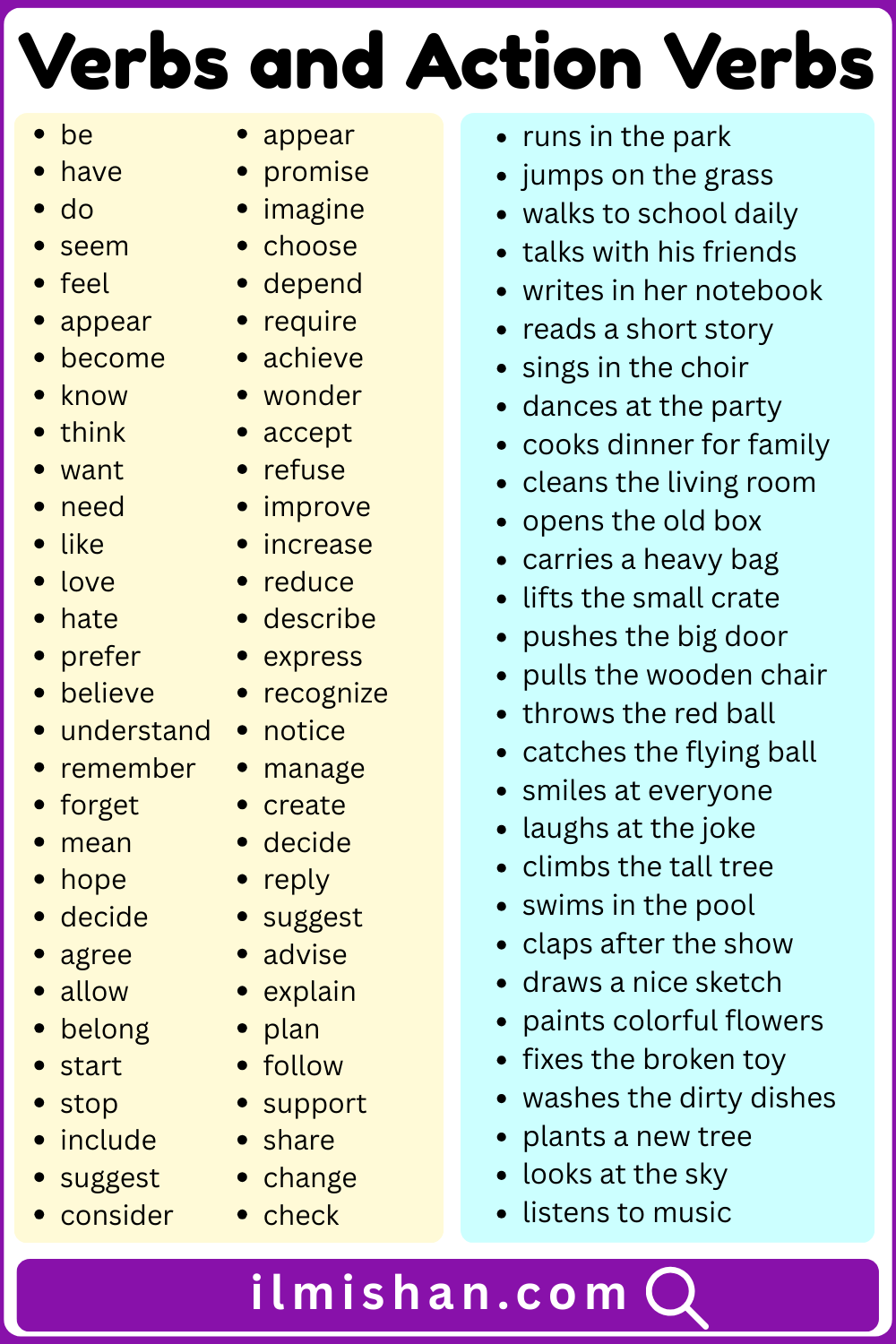
- run
- jump
- walk
- talk
- write
- read
- sing
- dance
- cook
- clean
- open
- close
- carry
- lift
- push
- pull
- throw
- catch
- smile
- laugh
- climb
- swim
- clap
- draw
- paint
- fix
- wash
- plant
- look
- listen
List of Predicate Phrases in English
- runs in the park
- jumps on the grass
- walks to school daily
- talks with his friends
- writes in her notebook
- reads a short story
- sings in the choir
- dances at the party
- cooks dinner for family
- cleans the living room
- opens the old box
- closes the window slowly
- carries a heavy bag
- lifts the small crate
- pushes the big door
- pulls the wooden chair
- throws the red ball
- catches the flying ball
- smiles at everyone
- laughs at the joke
- climbs the tall tree
- swims in the pool
- claps after the show
- draws a nice sketch
- paints colorful flowers
- fixes the broken toy
- washes the dirty dishes
- plants a new tree
- looks at the sky
- listens to music
List of Verbs and Predicates in English
Learn more helpful articles