

What Are British and American English?
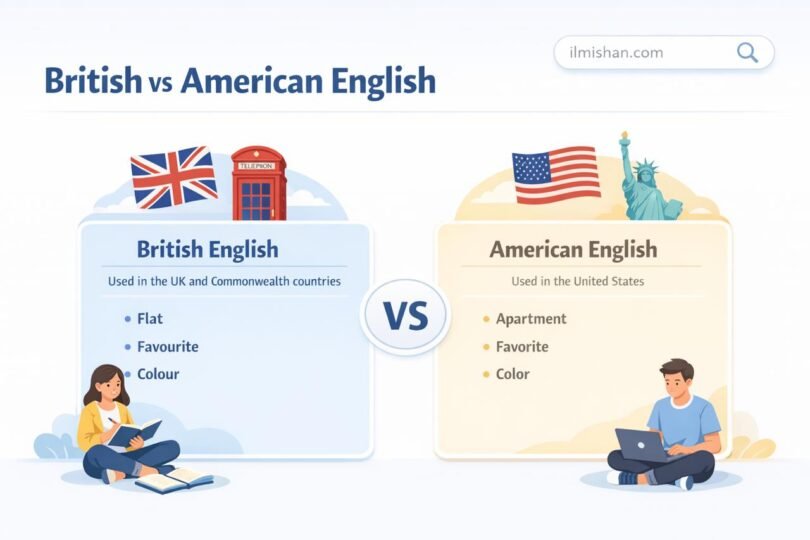
British English is the form of English used in the United Kingdom and many Commonwealth countries.
American English is the form of English used in the United States.
Both varieties share the same roots, but over time they developed different styles.
Main Differences Between British and American English
1. Spelling Differences
One of the most noticeable differences is spelling. British English often keeps traditional spellings, while American English uses simpler forms.
| British English | American English |
|---|---|
| Colour | Color |
| Favourite | Favorite |
| Centre | Center |
| Theatre | Theater |
| Travelling | Traveling |
| Defence | Defense |
👉 Key Idea:
British English often uses -our, -re, -ce, while American English uses -or, -er, -se.
2. Vocabulary Differences
Some everyday words are completely different in both forms.
| British English | American English |
|---|---|
| Flat | Apartment |
| Lift | Elevator |
| Lorry | Truck |
| Biscuit | Cookie |
| Petrol | Gas |
| Holiday | Vacation |
👉 Example Sentences:
- British: I live in a flat.
- American: I live in an apartment.
3. Pronunciation Differences
Pronunciation (accent) is another major difference.
- British English often does not pronounce the “r” at the end of words.
- American English usually pronounces the “r” clearly.
👉 Examples:
- Car → British: cah | American: car
- Water → British: wo-tuh | American: wa-der
👉 Tip:
There is no “right” accent. Choose one and stay consistent.
4. Grammar Differences
There are small but important grammar differences.
a) Present Perfect vs Past Simple
- British English often uses present perfect
- American English may use past simple
👉 Examples:
- British: I have just eaten.
- American: I just ate.
b) Collective Nouns
- British English treats group nouns as plural or singular
- American English treats them mostly as singular
👉 Examples:
- British: The team are playing well.
- American: The team is playing well.
c) Prepositions
Some prepositions are different.
| British English | American English |
|---|---|
| At the weekend | On the weekend |
| In a team | On a team |
| Different to | Different from |
5. Past Forms of Verbs
Some verbs have different past forms.
| British English | American English |
|---|---|
| Learnt | Learned |
| Dreamt | Dreamed |
| Burnt | Burned |
| Spoilt | Spoiled |
👉 Both forms are often accepted, but usage depends on region.
6. Date and Time Format
The way dates are written is different.
| British English | American English |
|---|---|
| 10 March 2026 | March 10, 2026 |
👉 This difference is very important in exams and formal writing.
7. Punctuation Differences
There are also small punctuation changes.
- British English uses single quotation marks (‘ ’) more often
- American English prefers double quotation marks (“ ”)
👉 Example:
- British: ‘Hello’
- American: “Hello”
Similarities Between British and American English
Even with differences, both forms are very similar:
- Same basic grammar rules
- Same sentence structure
- Most vocabulary is shared
- People can easily understand each other
👉 Important: Learning one form helps you understand the other.
Which One Should You Learn?
- Choose British English if you follow UK-based education systems
- Choose American English if you prefer global media, movies, or business English
👉 Best Advice:
Stick to one style in exams and writing to avoid confusion.
Common Mistakes ESL Students Should Avoid
- ❌ Mixing spelling styles (e.g., colour + center in one sentence)
- ❌ Using wrong date format in formal writing
- ❌ Confusing vocabulary (e.g., biscuit vs cookie)
- ❌ Ignoring pronunciation differences

What Are British and American English