
Verbs are one of the most important parts of English grammar because they show what someone does or what happens in a sentence. However, not all verbs describe physical actions. Some verbs express a state, feeling, or condition, while action verbs clearly show movement or activity. Understanding the difference between general verbs and action verbs helps students build correct sentences and improve their writing skills. In this article, you will learn Difference Between Verbs and Action Verbs definition with Example, making it easier to understand how they work and how to use them properly in everyday English.
Table of Contents
ToggleWhat Are Verbs?
A verb is a word that tells us what happens, what something is, or what condition exists.
A verb may show:
- An action
- A state
- A condition
- A feeling
- Existence or being
Verbs are the heart of every sentence because they tell us something about the subject. Without a verb, a sentence is incomplete.
Examples of Verbs in Sentences
- She is happy. (state)
- They feel tired. (condition/feeling)
- The baby sleeps peacefully. (action)
- Birds exist in many colors. (existence)
- He has two books. (possession)
What Are Action Verbs?
Action verbs are verbs that show physical or mental actions. These verbs tell us what a person, animal, or thing does.
Action verbs show movement, activity, or any task performed by the subject.
Examples of Action Verbs in Sentences
- She runs every morning. (physical action)
- They write notes in class. (physical action)
- I think about my goals. (mental action)
- The dog jumps over the fence. (physical action)
- Students solve problems carefully. (mental action)
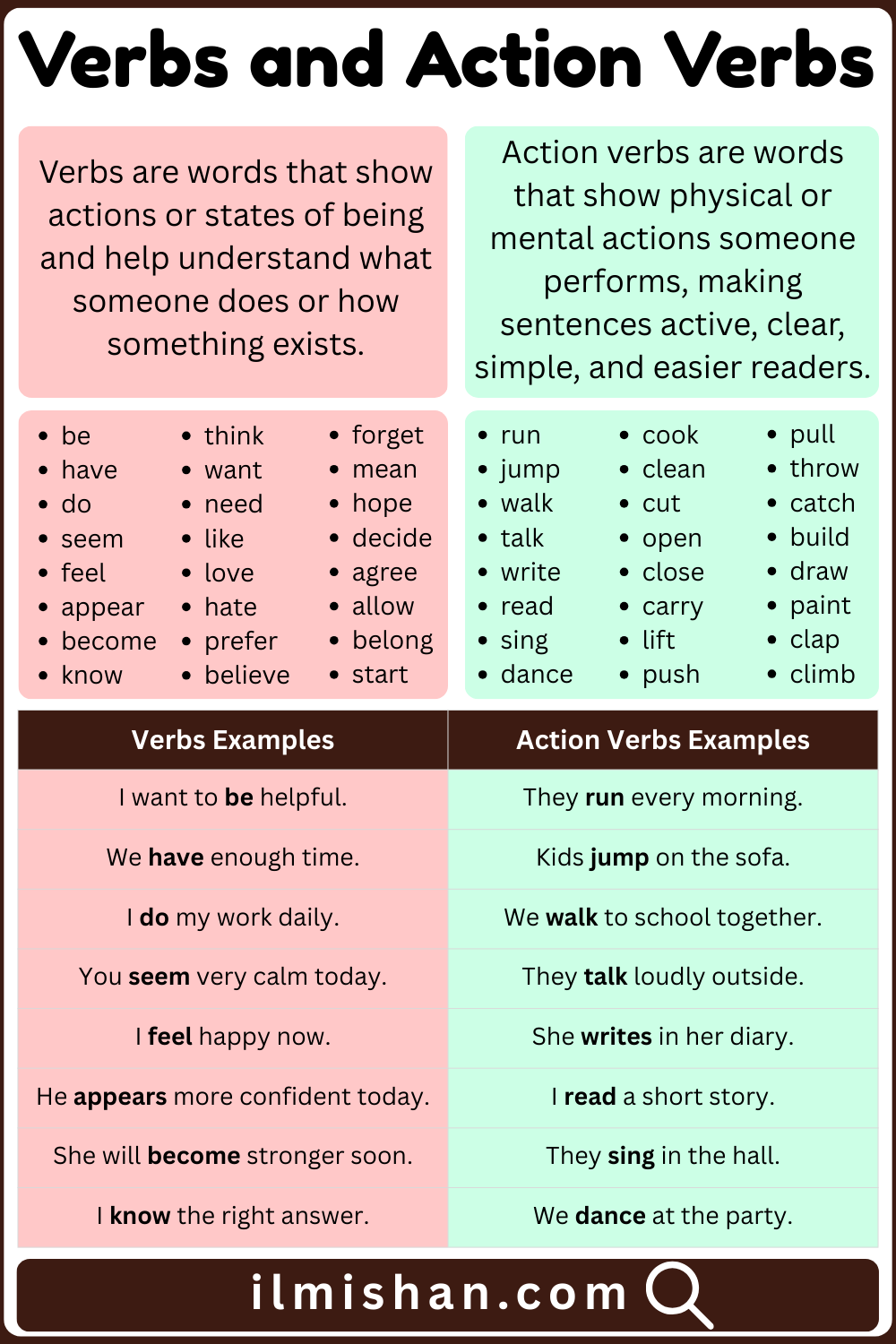
Simple Verbs vs Action Verbs in English
Key Difference Between Verbs and Action Verbs
To understand the difference more clearly, look at the simple explanation below:
- Verbs include all types of verbs: action, linking, auxiliary (helping), state, and condition verbs.
- Action verbs are a category of verbs. They only express actions done by someone or something.
Comparison Table
| Feature | Verbs | Action Verbs |
|---|---|---|
| Meaning | Tell action, state, condition, or existence | Show only physical or mental actions |
| Types | Many types: action, linking, helping, state, modal, etc. | One single type of verb |
| Purpose | Describe what happens in general | Show what someone does |
| Example | is, are, feel, seem, have, become | run, jump, write, think, play |
Detailed Explanation: Verbs vs. Action Verbs
1. Verbs Can Show States or Conditions
Not all verbs show action. Some only describe a condition or state of being.
Examples:
- is, am, are, was, were
- seem, appear, become
- feel, look (when they describe condition, not action)
Sentence Examples
- She is tired.
- They seem confused.
- The sky looks clear.
These verbs do not show any physical or mental action. They only describe a state.
2. Action Verbs Only Show Doing Words
Action verbs tell us what someone is doing. They can be:
- Physical actions (run, jump, cook, drive)
- Mental actions (think, decide, imagine, plan)
Sentence Examples
- The chef cooks delicious food.
- I decide my goals wisely.
- Children play in the park.
Every action verb answers the question:
“What is the subject doing?”
3. All Action Verbs Are Verbs, But Not All Verbs Are Action Verbs
This is the most important point for ESL students.
- “Run” is an action verb → it shows action.
- “Is” is a verb → but not an action verb.
- “Think” is an action verb → mental action.
- “Seem” is a verb → but not an action verb.
Types of Verbs That Are Not Action Verbs
To understand the difference better, here are some verb types that do not show action:
1. Linking Verbs
They connect the subject to its description.
Examples:
- be, am, is, are, was, were
- become, seem, appear
Sentence:
-
She is a teacher.
2. Helping (Auxiliary) Verbs
They help the main verb show time or mood.
Examples:
- will, shall, has, have, had
- can, could, may, might
- do, does, did
Sentence:
-
They are playing cricket.
3. State Verbs
They show feelings, thoughts, or conditions.
Examples:
- know, believe, own, belong, like, love
Sentence:
- I believe you.
These verbs do not express an action, so they are not action verbs.
Examples: Verbs and Action Verbs in Comparison
Here is a clear view for students:
| Sentence | Verb | Type |
|---|---|---|
| She is happy. | is | State verb |
| The dog runs fast. | runs | Action verb |
| I know the answer. | know | State verb |
| They play football. | play | Action verb |
| He seems sad. | seems | Linking/state verb |
| We write essays daily. | write | Action verb |
How to Identify an Action Verb in a Sentence
Use this simple test:
Step 1: Find the verb.
Step 2: Ask, “Is this something a person or object can do?”
If the answer is yes, it is an action verb.
Example:
-
She laughs loudly.
Can she “laugh”? Yes → Action verb.
Another example:
-
He is tall.
Can he “is”? No → Not an action verb.
Examples of Verbs and Action Verbs in English
| Verbs Sentences | Action Verbs Sentences |
|---|---|
| She is happy today. | She runs every morning. |
| They are in the garden. | He kicks the ball hard. |
| He was tired after work. | She paints beautiful pictures. |
| The baby seems hungry. | They build sandcastles at the beach. |
| She feels cold tonight. | He throws the keys to me. |
| The weather looks nice. | She opens the window slowly. |
| He becomes quiet in class. | They clean the room together. |
| The soup tastes good. | He writes notes carefully. |
| She has many ideas. | She cuts the vegetables quickly. |
| They want more time. | He carries the bag for her. |
| He likes warm tea. | She claps for the singer. |
| The movie starts soon. | They jump over the puddle. |
| She knows the answer. | He fixes the bicycle easily. |
| He thinks about his work. | She grabs the last cookie. |
| They live near the park. | He catches the ball fast. |
| She needs some help. | They push the door open. |
| He believes in hard work. | She lifts the heavy box. |
| They feel very welcome. | He washes the car outside. |
| She understands the lesson. | They plant trees in the yard. |
| He remembers your name. | She throws the paper away. |
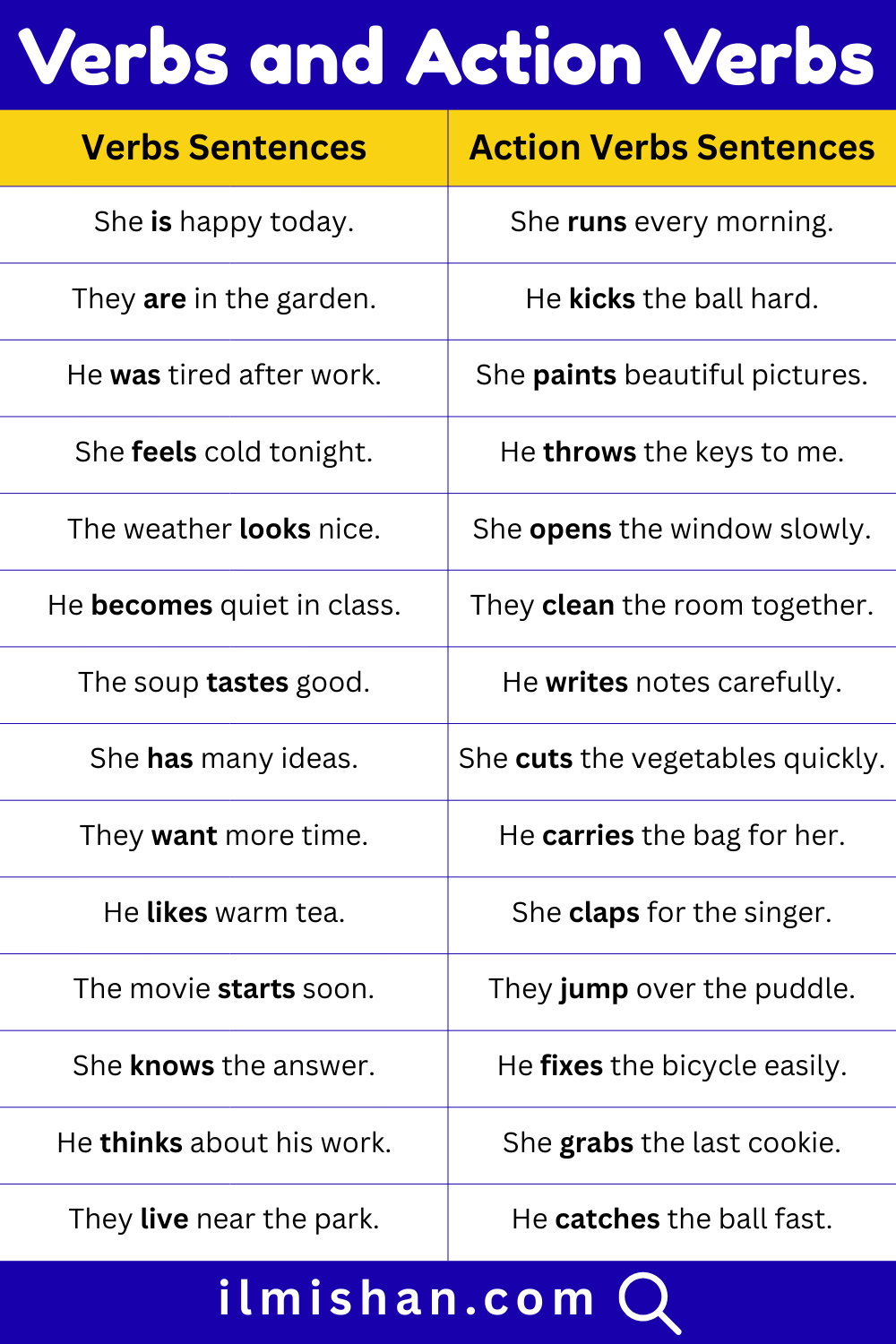
Examples of Verbs and Action Verbs in English
List of Verbs and Action Verbs in English
- be
- have
- do
- seem
- feel
- appear
- become
- know
- think
- want
- need
- like
- love
- hate
- prefer
- believe
- understand
- remember
- forget
- mean
- hope
- decide
- agree
- allow
- belong
- start
- stop
- include
- suggest
- consider
Action Verbs List
- run
- jump
- walk
- talk
- write
- read
- sing
- dance
- cook
- clean
- cut
- open
- close
- carry
- lift
- push
- pull
- throw
- catch
- build
- draw
- paint
- clap
- climb
- swim
- smile
- shout
- fix
- wash
- plant
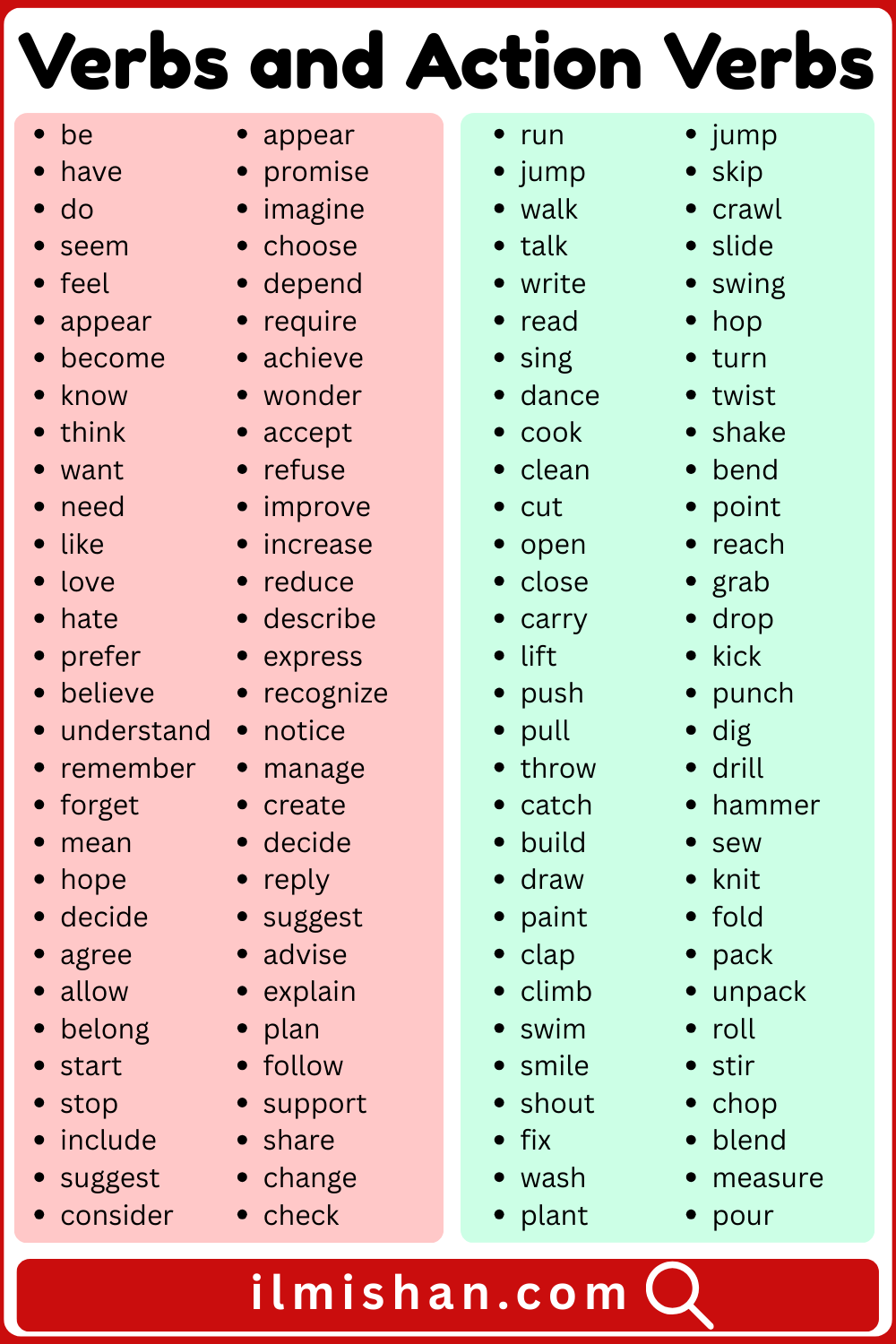
List of Verbs and Action Verbs in English
Learn more helpful articles